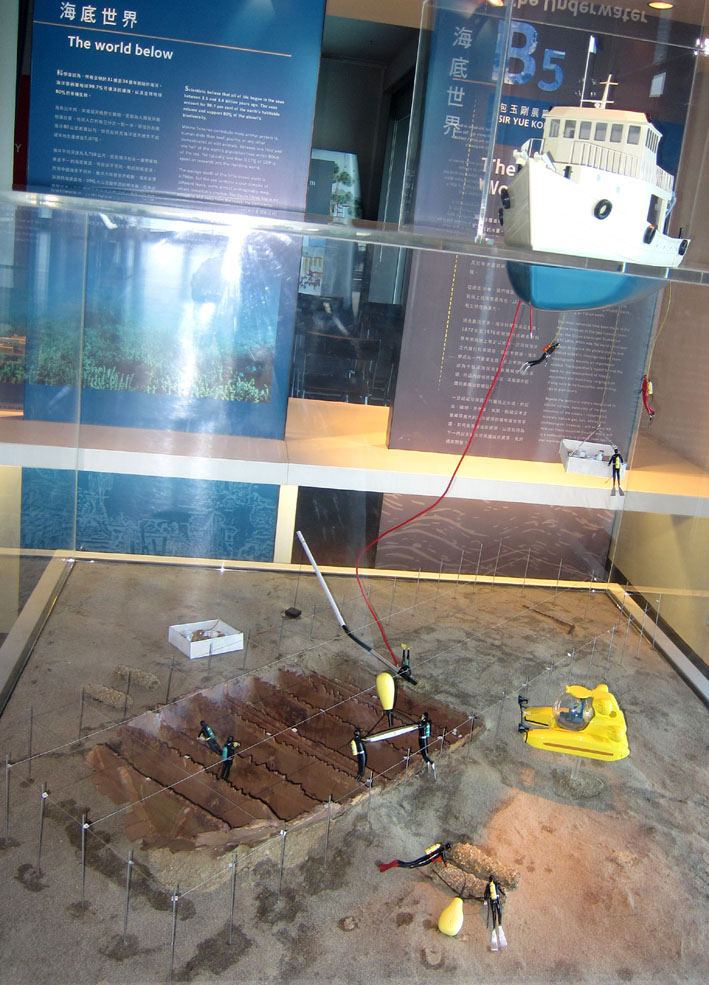
Excavating, Documenting and Interpreting Underwater Archaeological Sites
Many underwater archaeological sites, such as shipwrecks are buried in sand or covered with hundreds of years
of coral growth. The excavation of a site may be carried out because it is under threat or because of the
desire to reveal its archaeological and historical significance.
Excavation is a destructive process; the archaeological team has just one chance to dig, record and recover
material in order to comprehensively interpret the findings. Working underwater can also be hazardous and
everthing needs to be carefully and systematically planned. Firstly a non-disturbance survey is carried out,
then a grid is placed over the site so the ship's structure and artefacts can be recorded in 3 dimensions.
A dredge, like a vacuum cleaner, is used to carefully remove the sand to reveal the ship's structure and contents.
Artefacts are very fragile and need to be handled carefully during the recovery, after which time they need
conserving to ensure they remain in a stable condition. An excavation of a month or two can generate many months
or years of work in researching, cataloguing, drawling photographing, artefact conservation, interpreting
and writing up the results of a project.
In most underwater archaeological projects the ship's structure will remain on the seabed, although the recording
implemented underwater could allow for a reprica of the site to be made, or even a replica of the ship.
At the conclusion of an excavation project, all equipment is recovered and the shipwreck is reburied and
monitored to ensure its continued preservation.
[画像撮影: 2015.11.20&22 香港海事博物館にて][拡大画像: x27127.jpg][拡大画像: x27129.jpg: 「水中考古学的サイトを発掘、
記録、分析する」と題する説明書き][拡大画像: x27130.jpg: 左同]
 Back to: Top Page |