|
One Selected Photo "Oceans & Ships"  Back to: Top Page | Back to: Top Page | |
発掘などに関する展示パネルの説明書き [国立民族学博物館(National Museum of Anthropology)/フィリピン・マニラ] 前ページに戻る
1 §01 .... The wreck of the San Diego was discovered at a depth of 170 feet. It contained more than 5,000 artifacts representing a veritable time capsule of the known world (America, Europe and Asia) at the time. ... §02 The Discovery of the San Diego サンディエゴ号の発見 The accounts of the battle of the San Diego and the Mauritius are incomplete. To rectify this, Patrick Lize, an historian, conducted extensive research in the archives of Seville, Madrid, and The Netherlands to look for new information that would shed light on the battle. From the testimony of 22 survivors, memoirs of two priests from Manila and the inventory of both the weapons and provisions on the San Diego, a more accurate reconstruction of the battle was made possible. §03 Franck Goddio, an underwater archeology enthusiast, and his team, in coordination with the National Museum and financially supported by Foundation Elf, conducted underwater explorations to find the San Diego. They discovered the wreck about 50 meters deep near Fortune Island, outside of Manila Bay. It was undisturbed and formed a sand-covered hill of 25 meters long, 8 meters wide and 3 meters high. A cannon rising out of the sand with the inscription 'Philip II' made the identification easier.
水中考古学者Franck Goddioおよび彼のチームは、フィリピン国立博物館と調整しながら、エルフ財団(Foundation Elf)の財政支援をえて
サンディエゴ号を発見すべく水中探査を実施した。ゴッディオ・チームはマニラ湾外のフォーチュン島(Fortune Island)沖1.4kmの
水深50メートル(180ft)で沈船を発見した。沈船の位置は1991年4月に特定された。海底では長さ25m、幅8m、高さ3mの砂の盛り上がりを
形成していた。砂からはみ出していた大砲には「フィリップII(Philip II)」と記され年代の鑑定を容易にした。
The astronomical ring is the only known example of this type, in terms of both its mechanism and its shape. Its exact function has not yet been determined, although it is known that the position of the Philippes on the map was calculated using a similar instrument. Other navigational instruments were recovered from the San Diego such as sounding weights and a ruler, which were more suitable for reading charts and navigating in coastal waters than for voyages on the open ocean.
These navigational instruments are a major scientific treasure. Recovered halfway around the world from Europe, they represent a much
delayed but altogether appropriate reply to Chinese inventions such as the compass, an 11th Century
Chinese innovation.
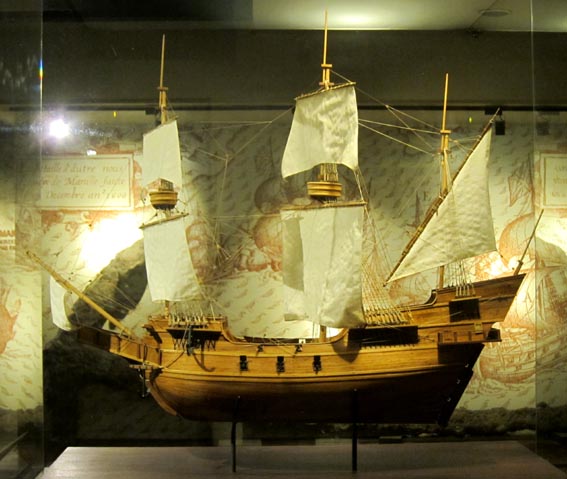
Mr. Robert Carpentier built the model of San Diego in 1995 The San Diego was a 3-masted trading ship built in 1590 in Cebu by Basque, Chinese and Philipino shipbuilders. It used different kinds of Asian woods and was about 35-40 meters long, about 12 meters wide and 8 meters high. It had at least 4 decks and could hold about 700 tons of cargo. Detailed investigations were only conducted on selected planks because of conservation problems. At large part of the wood remains were left under-water and covered with sand for future researches."
サンディエゴ号について:16世紀のガレオン。
バスク、中国、フィリピンの造船者によって1590年に建造された3檣の貿易船であった。16世紀の沈船が発掘されるのは極めて珍しい。
さまざまなアジアの木材が用いられ、長さ約35-40メートル、幅約12メートル、高さ8メートル。少なくとも4層甲板をもち、
貨物約700トンを積載できた。詳細な調査は特定のプランクス (厚板 planks) のみで、保存上の問題があるので大半の部材は
海中の砂の中に埋め留められ、将来の研究に託された。
The new ocean route linked the archipelago to the American continent. A new era of colonization began. Miguel Lopez de Legazpi undertook the conquest of Luzon. Manila was established in 1571. Thus began a profitable trans-Pacific trade, with Manila at the center. Beginning in 1573, two galleons sailed from Acapaulco each year, and returned from Manila laden with silk, spices and porcelains. Spanish doubloons, made from silver mined in Peru and minted in Mexico, flowed in the coffers of the Ming emperors, whose empire thereby entered the world economy."
マニラ・ガレオン その新しい海のルートはフィリピン群島とアメリカ大陸とを結び付け、新しい植民地化の時代が始まった。 レガスピー(Miguel Lopez de Legazpi)はルソンの征服を行なった。マニラは1571年に創建され、マニラを本拠地にして利益を生む 太平洋横断交易が始まった。
1573年になって始まったのが、2隻のガレオン船が毎年アカプルコから船出した。そして絹織物、スパイス、陶磁器などを満載して
マニラから復航した。スペインの「昔のスペインのダブロン金貨」、ペルーで採掘されメキシコで鋳造(minted)された銀から
製造されたダブロン金貨、その財貨は中国の明の皇帝の国庫に流れ、それによって中華帝国は世界経済へと組み込まれた。
The accounts of Marco Polo about the riches of Cathay (China), Xipangu (Japan) and India became the incentive for Columbus' westward voyage. With the Moor's expansion travel via this route was hindered, Spain and Portugal were forced to seek alternative sea routes. Magellan discovered the new route by circumnavigating the world. This route allowed for more goods, including spices, porcelain and silk to be brought to Europe. Through the Treaty of Tordesillas (1494) the world was divided into a western Spanish part that included the America and the Pacific Ocean that was unknown at that time and an eastern Portuguese part that included Southeast Asia. This, however, did not last long because England, France and Holland decided to organize their own expeditions. マルコポーロの話、カタイ(中国)、ジパング(日本)、インドの豊かさはコロンブスの西廻りの航海に向かわせた。 モーア人の膨張によって陸の東西ルートは妨害され、ポルトガルとスペインは別の海上ルートを模索することを余儀なくされた。 マゼランは世界を周回することで新しいルートを発見した。このルートはさらに物品、スパイス、陶磁器などをヨーロッパにもたらす ことになった。
1494年のトルデシリャス条約(Treaty of Tordesillas) によって、世界は当時知られていなかったアメリカと太平洋を含む西半球を
スペインに二分割し、東南アジアを含む東半球をポルトガルに分割した。だが、英国、フランス、オランダが自身の探検を組織することになり、
長くは続かなかった。
Up to four ships were used all year round. Spanish merchants used Indian slaves to extract silver from South American mines for export China and in return, luxury goods, including porcelain, silk and spices were sent to Mexico. Mule trains were used to transport the goods over land from Acapulco to Vera Cruz where they were shipped off to Seville and other places."
太平洋-「スペインの湖」
スペイン商船は、南米の鉱山から銀を採掘し、中国に輸出するためにインド人奴隷を使った。代わって陶磁器、絹、スパイスなどの贅沢品が
メキシコに輸送された。荷運び用のらばの隊列をもって、アカプルコから陸路でカリブ海側の港市ベラクルスまでそれら商品が運ばれ、
さらにスペインのセビリヤなどへと海送された。
Alexander the Great's military expedition to India in the 14th Century B.C. and diplomatic missions dispatched by the Emperor Han Wudi in the 2nd Century A.D. are two of the earliest examples in a long history of political and military contacts.
At the beginning of the modern era, two routes were established: one overland, the SILKROAD, and the other by sea,
THE SPICE ROUTE. The Silk Road had been one of the most important arteries of communication
since appropriately the year 1000, while the Spice Route grew in importance, especially during the Renaissance.
Through political maneuvering he was promoted to admiral and later commissioned the San Diego, a merchant vessel anchored in Manila, to be a battelship. Morga thought that a swift victory over the exhausted intruders would put him in a favorable stead with the King. Morga's ignorance as a captain was proven during the sea battle with the Dutch. He gave wrong commands that led to the sinking of the San Diego, but as one of the few survivors, he successfully depicted as a hero of the battle and even got promoted. He was sent to Mexico in 1603 and to Peru in 1615.
アントニオ・デ・モルガ (1559 - 1636)の略歴: モルガンはセビリヤの銀行家の出身。スペイン国王により1593年フィリピン総督の顧問および
中将(Lieutenant Genera)に任命された。当時商船であったサンディエゴ号がマニラに停泊した、その船を軍船に転換するのを任された。
そして、折りしもフィリピン水域に侵入してきたオランダの海賊船「モーリシャス号」を拿捕し、フィリピンから離任するための
戦功をようとした。モルガンはその海戦で艦長としての無知をさらけ出し、彼の誤った指揮によりサンディエゴを沈没させてしまったと
される一方で、目撃者の証言から海戦の英雄であると評され、めでたく出世を得て1603年メキシコへ、1615年にはペルーへと赴任した。
In the latter part of 1600, van Noort, reached the Philippines with two ships. On December 14, the battle between his flagship Mauritius and Morga's San Diego took place in front of Manila Bay. Although far outnumbered, 59 to 450, his men fought bravely. Van Noort tricked the Spanish into fleeing by setting fire to his own sails. Through his nautical skills and tactical cunning, he was able to escape the Spaniards. One year later, van Noort returned to Rotterdam broke. The expediton was a failure. But his knowledge of the trade route, allowed Dutch participation in the spice trade in the Moluccas. Belatedly acknowledged, he finally took a post as garrison commander until 1626 when he retired.
オリヴィエール・バン・モールト (1558/9 - 1627)
1年後路ロッテルダムに戻る。探検は失敗した。だが、交易ルートに関する彼の知識はモルッカでの香料貿易へのオランダの関与を可能にした。
彼は後に守備隊司令官(garrison commander)としてのポストに1626年まで就き、同年に退職した。
A major leak was discovered in the hold, obviously a result of the violent impact. Morga gave the fatal order t o cast off the lines holding the ships together.
The astonished Dutch could not believe their eyes. When the lines had finally been cut, the San Diego sailed 330-660
feet (100-200m), nosed over and went straight to the bottom. The time was appropriately 3:00 p.m. on Thursday, December 14, 1600.
Three hundred people are thought to have drowned. Another hundred apparently survived by swimming to nearby Fortune Island.
Morga himself was rescued by his secretary.
Unfortunately, this was also the weekness of the San Diego. Morga had the ship full of people, weapons and muntions but too little ballast to weigh the ship down for easier maneuverability. While the gun ports had been widened for more firing range, not one cannon could be fired because water enter through the enlarged holes. The San Diego sprung a leak beneath/ the waterline either from the first cannonball fired by the Mauritius or from the impact of ramming the Dutch at full speed. Because of inexperience, Morga failed to issue orders to save the San Diego, it sank "like a stone" when he ordered his men to cast off from the burning Mauritius. The events were recorded in Morga's book, "Sucesos de las Islas Filipinas". The book portrayed Morga as a hero of the battle. Olivier van Noort also wrote about the battle.
サンディエゴの沈没: マニラの南西50km沖合でモルガ指揮のサンディエゴ号とオランダ船モーリシャス号が戦闘。サンディエゴ号は
モーリシャス号より4倍も大きかった、マニラの要塞から持ち込んだ14の大砲装備、450人もの休養中の兵員など。
不幸にもサンディエゴ号の弱み: 人員、兵器類、武器弾薬、操縦性を容易にする船のバラストが余りにも少なかった。モルガンの経験不足で
結局は船を救えなかった。
The operation was commanded by the "oidor" Antonio de Morga, a bureacrat with little military experience. The Spanish fleet, composed of two ships and supported by smaller native boats, set sail on December 12, 1600.
The battle plan was prepared on December 13, and the battle between the San Diego and the Mauritius began
at dawn on the 14th, in a strong wind and heavy seas.
Nevertheless, centuries under water have destroyed most of the ship's weaponry. The defensive equipment - helmets, backplates, breastplates and coats of mail - survives only in the form of a few severely corroded fragments, while even less remains of the offensive weapons - harquebuses, muskets and swords.
All that has been found are a few accessories such as pins, buckles, hangers and medallions,
which in themselves prove that the ship carried a large contingent of armed men.
The cannons were fabricated in the Philippines, Flanders and Portugal. There were 8 grades of caliber which requied different types of munition. The iron cannon balls were for the smaller cannons and the stone cannon balls for the bigger ones. The cannon balls weighed between one and seven kilograms. The cannons from Portugal were more advanced and were called breech loaders. A glimpse of the soldier's outfits came from pieces of armour, belts, and shoe buckles recovered, as well as swords and muskets. In addition, a ball mould to press musket and arquebus balls was found.
A pair of Japanese swords and two dozen sword decorative elements point to the possibility of high ranking Samurais
on board, probably mercenaries.
[参 考] ・ Spanish galleon trade route: スペインのガレオン貿易ルート ・ inter-island trade: 島嶼間の交易 ・ East India Company trade route: 東インド会社の貿易ルート ・ Marco Polo: マルコ・ポーロ/the riches of Cathay (China), Xipangu (Japan): カタイ(中国)、ジパング(日本)の富 [画像撮影: 2018.3.24. フィリピン・マニラ/国立民族学博物館にて][拡大画像: x28162.jpg][拡大画像: x28163.jpg]
辞典内関連サイト
|
 2
2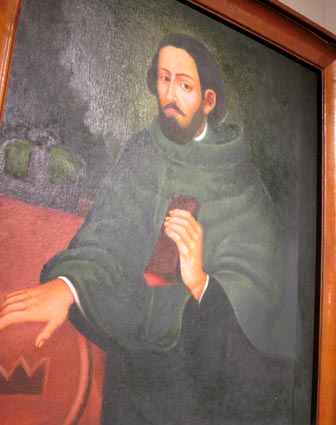
|
One Selected Photo "Oceans & Ships" Back to: Top Page | |